There's a running joke in our team about the head of operations at our Caribbean bases.
He oversees the docks, the crews, the boats — the whole clockwork of one of the world's largest yacht charter businesses. And according to everyone who had ever tried to get time with him: he is impossible to reach.
Not in a rude way. Just in the way that truly important people with truly important problems are impossible to reach. His name came up constantly in conversations about the business. "He needs this." "He's been asking for that." "Have you spoken to him?" But nobody ever had.
So when a colleague told me he had reached out — directly — about a problem he wanted us to help solve, I paid attention.
Turning around two to three hundred yachts at a base is not a simple logistics exercise.
Every boat comes in after a charter. It needs to be cleaned, inspected, restocked, and prepped for the next guest — often on a tight turnaround. To do that, you need people. The right number of people, at the right time, with the right contracts in place well ahead of schedule.
The planning that went into figuring out how many workers were needed, when, and for which boats had — up until now — been done manually. Spreadsheets. Institutional knowledge. Hours of careful, painstaking work every single day by someone at the base who knew the rhythms of the business inside out.
It worked. But it was fragile, slow, and entirely dependent on one person doing it by hand.
The ask was clear: could we build something that predicts staffing needs in advance, so the base could arrange contractual workers ahead of time and serve guests the way they deserved to be served?
At the end of that first call, the operations leader said something I've never forgotten.
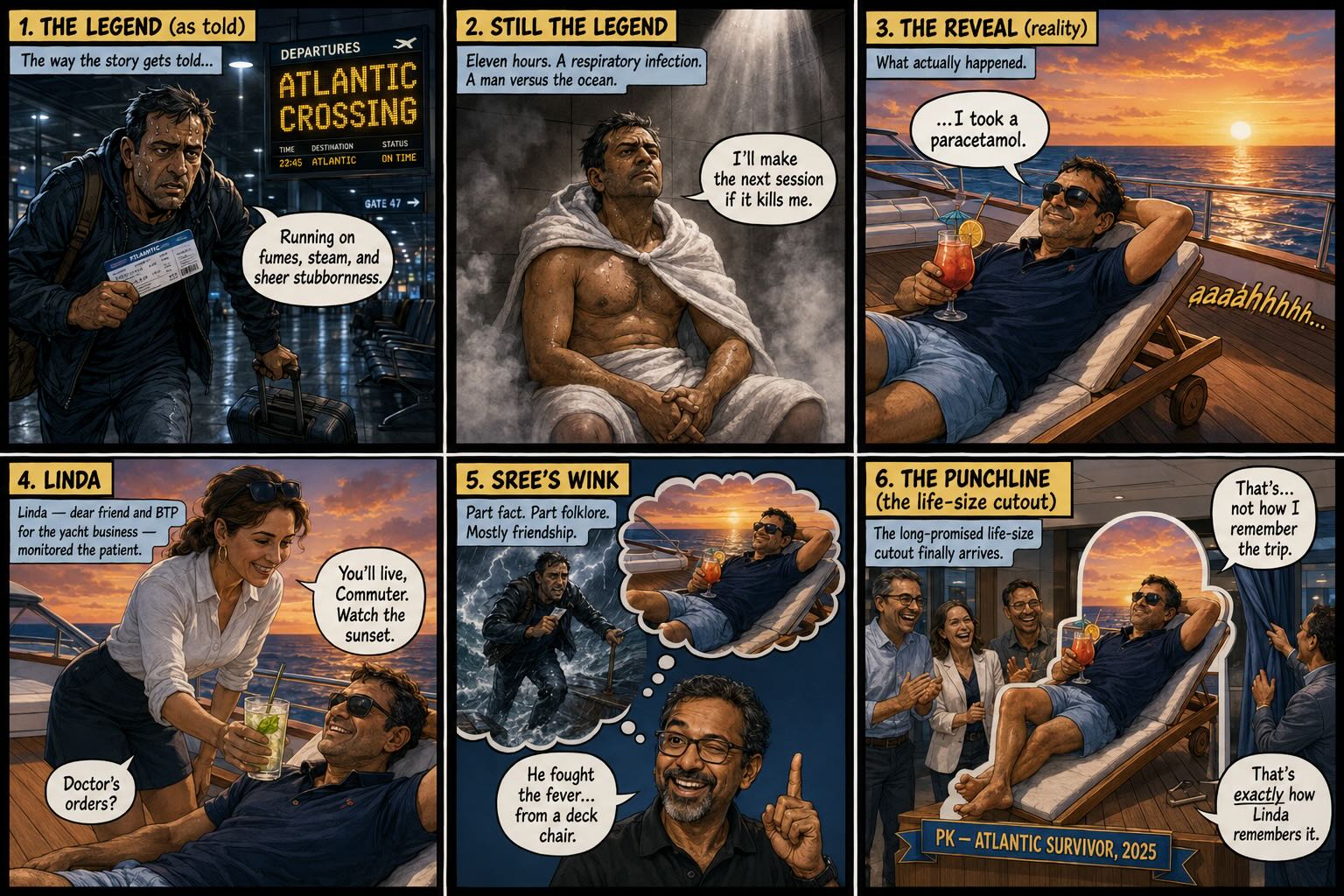
"If you solve this problem for us, we'll get you a life-size cutout at the base. It's that important."
I laughed. I said I was looking forward to seeing myself in the lobby.
The conversations began in November. Multiple sessions with operations leaders who each brought different depths of knowledge — how the base worked, where the pain lived, what success would actually look like.
And pretty quickly, we could see the full picture. The complete solution would need an automated data pipeline, a module capturing how long it takes one person to clean a particular type of yacht, and a prediction engine that pulls it all together to forecast exactly how many people are needed and when. It was a clear, logical system. And with the way our team had been embedding AI into how we work — not just talking about it, but using it daily in how we designed, developed and problem-solved — we knew we could build the whole thing relatively fast.
That's where the real decision had to be made.
The prevailing energy in the industry right now is: AI moves fast, so you should too. Build it all. Ship it. Iterate. The cost of being wrong is lower than ever, so why not go big?
We went the other way. Deliberately and consciously.
We chose to build just the first piece — what we came to call the Ops Planner — and here is exactly why.
First, accuracy compounds. The prediction engine at the end of this system is only as good as the data that feeds it. Getting the foundational layer right — the automated pipeline, the clean structured data — was not just step one. It was the thing everything else would stand on. Rushing past it to build the full system would have meant building on sand.
Second, the people on the ground needed to trust it before they could rely on it. Introducing the full system all at once would have been a significant change to how the base operated. By starting with the ops planner, we gave the team something concrete to test, validate, and build confidence in. Their feedback at this stage would make every subsequent module better.
Third, change takes time — even good change. A big-bang rollout is a risk not just technically but humanly. An incremental approach let the base adapt at a pace that worked for them, which meant adoption was genuine, not forced.
So yes — we could have moved faster. We chose not to.
By the end of January, we started the build in earnest. And we moved quickly — because that is genuinely what AI-assisted development enables when a team has built the right habits around it.
Within weeks of starting, we had the first version live in production. The person who had been spending two to three hours a day on manual planning looked at the tool and said — only half joking — "Is my job at stake?"
That was our first real milestone. Not a demo. Not a prototype. A live tool, doing real work, earning real trust.
By March, the ops planner was already running in production. So the trip to the base wasn't a discovery mission. It was a deepening — understanding what the next set of problems looked like, from the people who lived them every day.
Getting there from India is almost the other end of the planet. On my way to the airport, I started feeling off. By the time I reached London, I knew I had a respiratory infection. Eleven hours later, landing at Antigua, I was barely standing. A two-hour layover. Another wait. A final short flight. And then the base.
I won't pretend those four days were comfortable. I was going into meetings and coming out to lie down before the next one. And in between — when I could steal twenty minutes — I was finding the nearest steam room, hoping the heat would clear my chest enough to get me through the next session. My body was running on fumes, steam, and sheer stubbornness.
But we had a full schedule of conversations with planners, dock staff, and operations managers. And — for the first time — I met the man whose name I'd been hearing for months. Direct, warm, deeply knowledgeable about his business. Someone who'd been asking for a solution to this problem for a long time, and was genuinely glad to see one already running.
We listened to what the tool still needed to do. And we came away with a clear picture of the next modules to build — things we could only have understood by being there.
Coming back, the work didn't slow down — it expanded. The visit had given us the clarity we needed to keep going, one deliberate step at a time.
By the end of May, the ops planner wasn't just running at the original location. It had been rolled out to multiple bases across the Caribbean. And the work on the next modules — informed by everything we'd seen and heard at the base — was underway.
After the trip, I learned something that reframed the whole journey for me: what our team had built was something the operations team had been asking for for almost a decade.
A decade.
Not because no one cared. Not because the problem wasn't understood. But because the tools, the team, and the approach hadn't come together until now.
We got there in weeks. And we got there right — because we chose the right first step.
If you take one thing from this story about AI, I'd want it to be this: AI has genuinely and dramatically compressed development cycles. What once took months can now take weeks. What once required large teams can be done by small, aligned ones. That is real, and it matters.
But speed creates a new kind of trap. When building is cheap and fast, the temptation is to build whatever feels right and figure it out later. To move instinctively. To ship and see.
The lesson I carry from this project is that even in a world of rapid development, disciplined product thinking matters more than ever. The skill of knowing what to build — and crucially, what to build first — doesn't get automated away. It becomes the differentiator.
But here's the thing I didn't expect to feel as strongly about when this all began: none of the judgment matters if the people around you aren't pulling in the same direction.
Think about what this project actually took. A colleague who believed in the opportunity enough to bring it forward. A developer who didn't just write code but cared about what it was for. A team at the base who tested honestly, gave real feedback, and extended trust to a group of people they'd never met in person. And an operations leader who handed us a decade-old problem and said — with a straight face and a laugh — go on then, prove it.
That's not just a team. That's an alignment. And it's rarer than any technology.
The life-size cutout is still pending. I remain optimistic.