Once we had some clarity on the art of the possible with AI — what it would mean for teams, ways of working, the discovery process, all of it — we decided to stress-test our thinking. Not with another whiteboard. With an actual project.
We had an internal tool. Almost a decade old. In its third version. We wanted to see what it would become in this AI-enabled world.
We were clear we didn't want a long discovery. But we also weren't going to skip alignment — with the actual users, with the business. Whatever we shipped had to be useful, not just fast.
So we ran a small one. The thing we now call dark mode — pretty much all of us in one room, intense, two or three days, ship a V1 at the end.
We came together to discuss the possibilities. Which one to choose. What to build.
And during that conversation, two tensions surfaced. Two tensions that, within a couple of hours, escalated into a shouting match between me and The Whisperer.
The first tension was about a safety harness.
The Whisperer's team had already built something. A V1 of sorts. Working. Ready to demonstrate.
I came in from the opposite direction. I'm a product person, and I'm used to discovery — the kind where you identify the problem statement clearly, without any bias toward a solution, and then let the solution emerge. Diverge. Converge. That whole rhythm.
So when The Whisperer wanted to demonstrate what they had already built, I resisted. Hard. Because once you show something, the business stakeholders are biased by what they see. They get constrained by it. They stop thinking inside the diverge-converge space and start thinking inside the box you just drew on the whiteboard.
That was my objection. I held on to it.
The second tension was about accuracy.
For some problems, accuracy is binary. 2+2=4. There is a right answer. Anything else is wrong.
But a lot of what we do — especially anything with a UI, anything where output depends on context and on who does the work — accuracy isn't a clean thing. You can have an acceptable result. But a precise definition of accurate? Very, very hard.
And part of the team was talking about accuracy as if it were 2+2. Another part was pushing back, saying accuracy in this space can never be guaranteed, never even fully achieved — which meant, framed that way, the project was a non-starter.
We didn't have the word acceptable yet. So we didn't have language for the disagreement.
It was around lunchtime. 12:30. Maybe 1 o'clock.
The Whisperer lost his cool. And so did I. Both of us were having a very, very heated, loud argument — the kind that stuns a room. Not just from the volume. From the intensity.
The team froze.
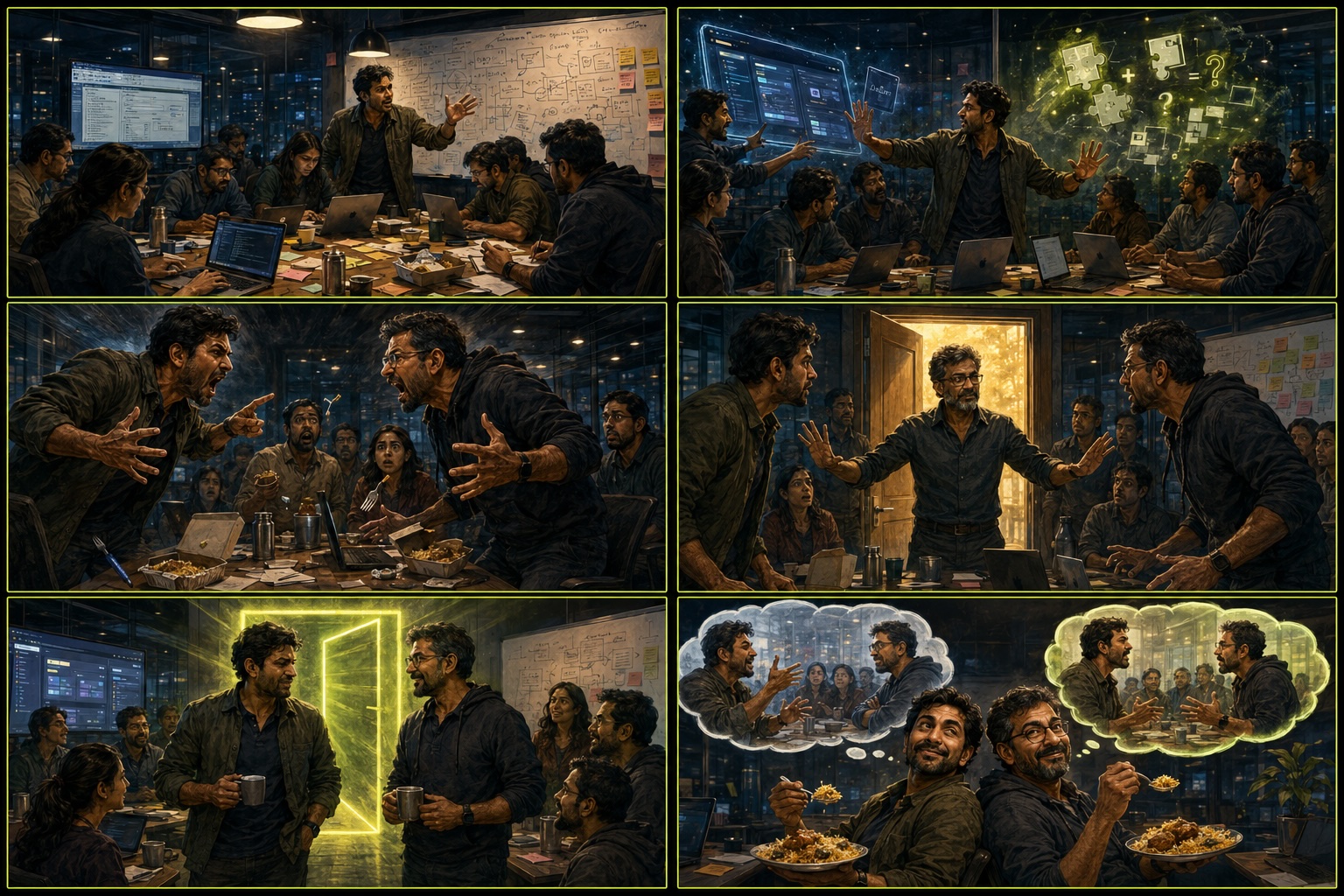
Thankfully — and this is the part I keep coming back to — Sri stepped in. Cooled us off. Gave both of us the space to reflect on what was actually causing the friction.
And here is what I love about working with people who carry very high trust and very low ego. That is what Sri and The Whisperer are, for me.
Once we sat down, we reconciled quickly. We found the vocabulary.
The first dilemma — yes, demonstrate. But we will consciously not let what we see decide whether it is the right solution. The demo is a demo. Not the answer.
The second dilemma — and credit to Sri for this — can we use the word acceptable instead of accurate? Because in this context, accuracy is undefined. Acceptable is not.
That was it. That was the vocabulary.
Within about 30 minutes of that conversation, we were way, way, way forward. The demonstration happened. The buy-in came. The V1 launched in the next couple of days.
So what is the story here.
It isn't that we shipped V1. We were going to do that anyway — that's what dark mode is for.
The story is that a loud fight, at lunchtime, in front of a stunned team — the kind of fight that could have set a project back by weeks — turned into 30 minutes of finding the right words.
A safety harness can co-exist with discovery. You just have to agree on what role each plays.
An acceptable result is not a softer goal than an accurate one. It is the right goal when accuracy itself is undefined.
And the people you fight loudly with — if there is trust between you, and no ego in the way — those are the people you can build with. Loud arguments aren't the danger. Loud arguments without vocabulary are.
If I had to leave a few quiet markers behind from this one — not as a tidy listicle, just as things a colleague might pick up later — they would be these.
We launched V1 a couple of days later. That part went into the project log.
But that's not the part of the story I tell at dinner.
The part I tell at dinner is this — sometime around 1 o'clock, in a room I won't name, two people who genuinely like each other shouted each other down. And then a third person opened a door, and we walked through it together.
And on the other side of the door was just one word.
Acceptable.
The correction — from the room's other half
Then The Whisperer read this. With biryani. (He knew where the key was.)
And then he messaged me.
I read it with biryani. Indeed me.
Now I'm curious. The tension was palpable. But the reason is incorrect.
While you pushed for us to demo the version the team had worked on immediately — literally you wanted that moment — I requested that we take a pause and gather after 15 minutes. I also mentioned that we need some time to set up and get ourselves in a frame of mind to be in a place to show what we have.
You still insisted that you prefer the demo to happen without break and did not allow me to speak and also paraphrased on my behalf. I said angrily — 'I give up.'
But of course we immediately gathered our respective composures and continued after the break. We also had a coffee together during the break.
I had to spend more time with our sales sponsor calming him down — with the assurance that it is just passion and nothing personal.
Wondering how the story has changed completely now.
I won't rewrite the paragraphs above. That is my memory of the day. Those are my words.
But the room had two people in it. And the second person remembers it the other way around.
I had the urgency. He asked for the pause. I paraphrased over him. And then we had coffee and walked back in.
The fight stayed real. The vocabulary still saved us. But the reason — who pushed and who paused — was apparently the opposite of what I just told you.
And honestly? The most aila.fun thing about all of this is that we still don't agree on the why. We agree on the shouting. We agree on Sri opening the door. We agree on the word acceptable. We just don't agree on who started it.
Which is exactly why there is a disclaimer at the top of every page on this site.
Memory is imperfect. Voices are interpreted. The corrections are part of the story.
Thanks, The Whisperer.
P.S. — there are now two versions
One more thing — and this is the best thing.
The Whisperer went and recorded his version of this story. Three parts. It's published here now, right next to mine.
And it turns out his version barely starts with the fight at all. It starts in Pondicherry, with a two-day build called Voice IQ, with a cancelled workshop and a vulnerable message — a whole world before the lunchtime I remember. The shouting shows up in his telling too. Just much later, and not quite where I left it.
We agreed — I won't touch a word of mine. He won't touch a word of his.
Two voices. One room. One fight. Two memories of who started it. Read his →
The Whisperer's version — Part 1: The Prologue →
That is how it should be.