February 2025. Pondicherry. Sri had just moved there, so when we wanted to take the whole the brand team somewhere that wasn’t a Bangalore meeting room, the choice made itself.
The plan was simple, and a little reckless. Two or three days. Explore the art of the possible, run a few mini-hackathons, diverge on ideas, converge on a couple, drop the team into a dark mode, and ship something small by the end.
That was the plan. Here’s what we actually learned.
The team was scared.
Not all of them, and never out loud. But a few of us had started dreaming about rewriting Lead Automation with AI — while another group was rebuilding the same platform the approved way, the traditional way, the way the business and The Champion had signed off on. Two tracks. One spoken about, one whispered. And the people outside the whisper could feel the draft under the door.
So this is the first thing Pondicherry taught me, and I wasn’t expecting it: change management isn’t a business problem. It lives inside the tech team too.
How do you build a room where it’s safe to fail — without making it so safe that nobody runs?How do we create a safe space which actually pushes people to dream the undreamable, which also gives a resistance to people that they are okay to fail, but at the same time stresses the importance of going very fast?
Because a safe space only earns its keep if the team can fall down and sprint again the same morning. The moment “it’s okay to fail” quietly becomes “take your time,” you’ve lost it. We were trying to hand people permission to dream the un-dreamable and a reason to move fast, in the same breath. That tension never really resolves. You just learn to hold it.
It was in Pondicherry, between sessions, that The Ghost and I started the thing that would quietly change everything. We didn’t announce it. We opened Cursor and Lovable, made a logo, and gave it a name: Voice IQ.
The brief — if you can even call it that — was tiny. Sri pulled us aside and said, more or less: “Don’t overthink it. The consultants already use Gemini, they already have the prompt. Just give them an easier way to get the transcript.”
At the time, getting a transcript was a small daily act of suffering. Take the call recording. Paste it into Gemini. Wait. Copy the transcript out. Paste it back in. Apply the prompt. Every call, by hand. Sri’s whole ask was: make that one step hurt less.
We did not make it hurt less.
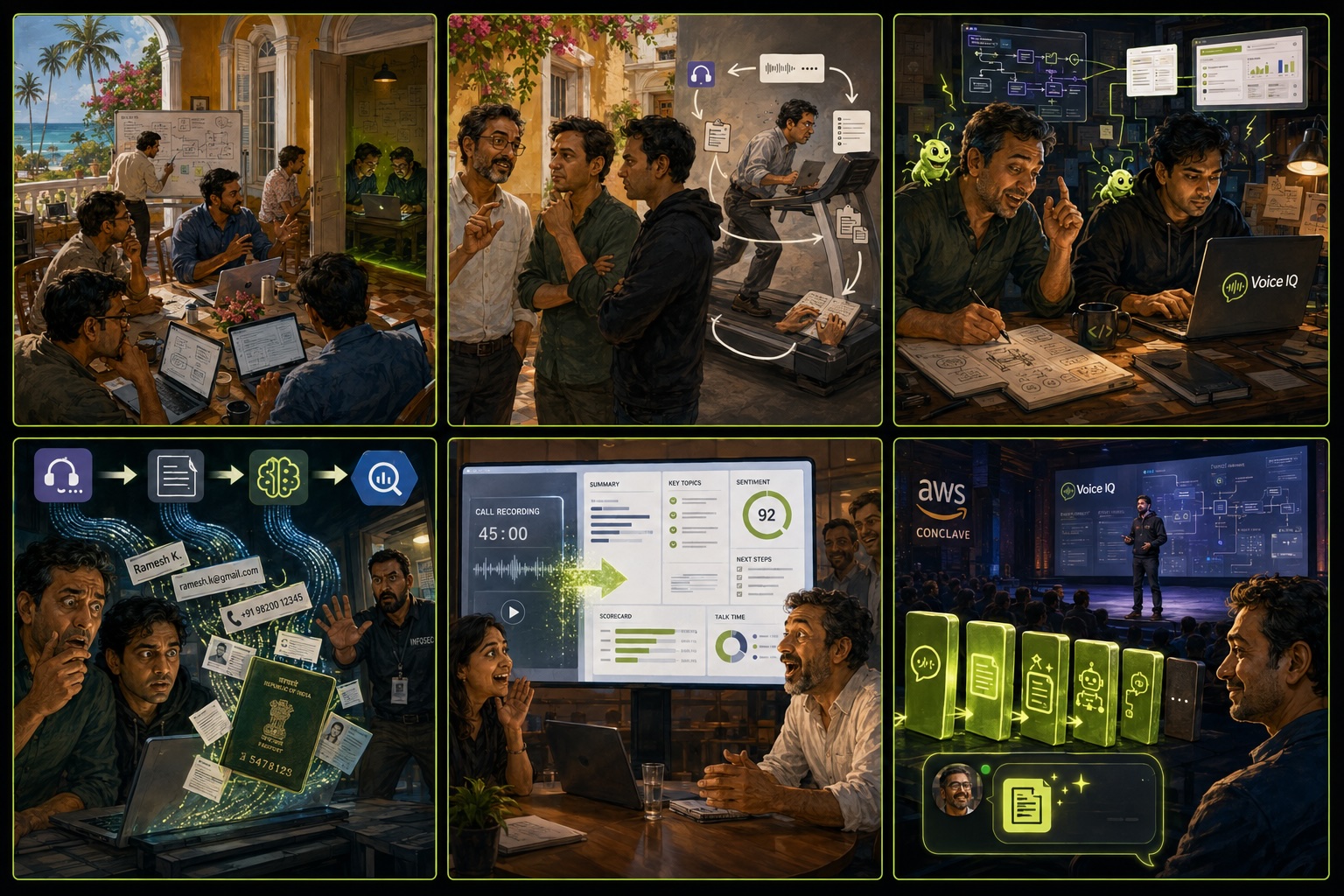
Being us, we went deeper. It’s an itch — kida, we call it in India — to poke at a problem until it gives. We started talking to The Believer, one of the consultants who’d actually live with the thing, and a rapport built — the kind that turns a feature into a product. (Somewhere in there The Coach got left in the dark for a stretch. Not on purpose. We were just galloping.)
The Ghost and I built Voice IQ as a pairing exercise — me describing, him making it real. Completely vibe-coded. Not built to scale, not safe to extend, held together with hope. I say that with pride. It was never meant to last. It was meant to prove a point. And it did.
Under the hood it was gloriously manual: pull recordings from Talkdesk by call type and disposition, transcribe with Gemini on Vertex AI, score them against a set of coaching prompts The Believer wrote — and they were good prompts — then surface it all on a dashboard. When it was ready to be real, The Builder productionised it under The Ghost’s eye. Fragile pipeline. Real output.
The eye-opener was the demo. Sri shared it in a group DM around the 7th of May — “some early thoughts on call analysis: Voice IQ, the Gen-AI POC we did for The Believer and our sales sponsor, as a test-and-learn.” It went into the sales and marketing session, and it landed.
For once, a POC of ours wasn’t shipped and forgotten. The business watched it work. And our sales sponsor and The Believer used four words I still think about:
Finding it a blessing.James and Matt finding it a blessing — that's not a polite feedback, and that's a business leader who has just seen something that makes their job meaningfully easier and can't believe it exists.
That’s what a leader says when something just made their job meaningfully easier and they can’t quite believe it’s real. A forty-five-minute call, turned into a structured, scored summary. No more sitting through recordings. Coach faster, spot the patterns, read the day instead of reliving it.
Here’s the part that mattered more than the feature.
Voice IQ was never really a transcription tool. It was a data pipeline — Talkdesk in, clean transcripts out, piped into AI, landing in BigQuery. And that pipeline became the ground floor for everything we built afterward. Because an AI is only ever as good as what you feed it. Garbage in, garbage out. Wisdom in, wisdom out. Every project that followed borrowed the same first principle: get your data sorted, build one source of truth, then let the AI feed.
It taught us something uncomfortable, too. Those transcripts were full of real people — names, emails, phone numbers. Someone found a passport number sitting in one. Not a hypothetical. A passport number. That’s the day we got serious about anonymising everything, and about bringing InfoSec into the room early instead of apologising to them later.
But the most important thing Voice IQ created wasn’t infrastructure. It was curiosity. our sales sponsor and The Believer had watched AI understand what was said on a call. The next question almost asked itself: if it can understand the call, can it write what should happen next?
And then The Champion sent the message that turned a side-project into a journey:
our sales sponsor and I are fleshing out another AI project — proposal generation.When Devika later wrote to Sri and Venki: James and I are fleshing out another AI project on AI proposal generation. So now you see where this is all heading — it's like a movie.
You can feel the movie starting, can’t you.
Months later, The Ghost stood up at an AWS Conclave and presented two of our use cases — Voice IQ and TC Copilot — back to the very people whose tools we’d built on. The unsanctioned weekend project had become something you put on a stage.
So that’s the prologue. It began with no budget, no mandate, no permission slip beyond “don’t overthink it.” Two people, a stolen weekend of attention, and a refusal to wait for the perfect brief.
If you ask me what fun means at our company, it’s this: a few curious, stubborn people who’d rather test something tonight than schedule a meeting about it. Can we try it now? Is it working? No? Okay — what’s broken, and how do we fix it before dinner?
Crawl before you walk. But crawl fast — and crawl while having fun.