The workshop wasn’t a week in Bangalore with laptops and whiteboards. Forget that picture.
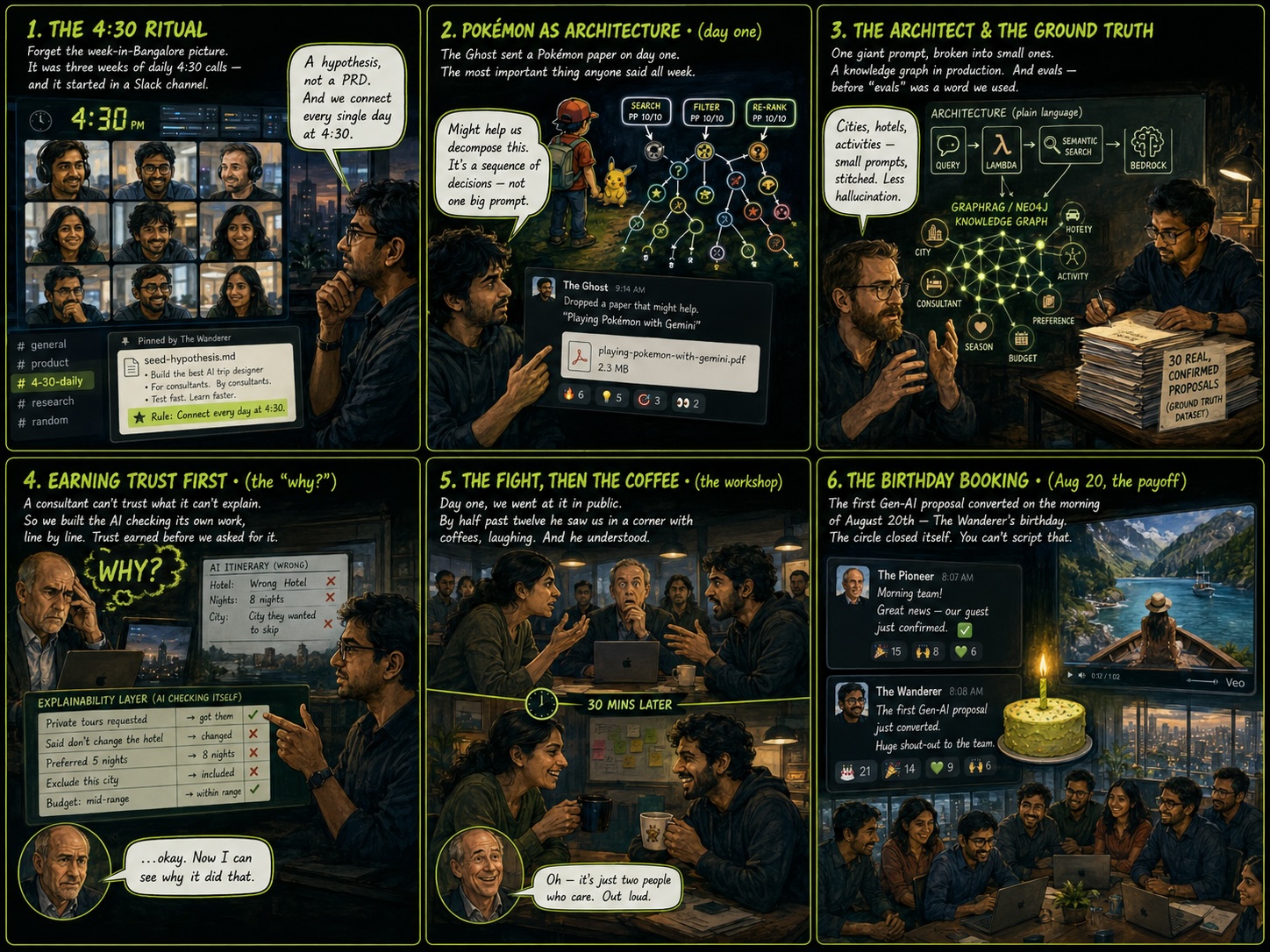
It was three weeks of daily 4:30 p.m. calls. It started with me giving context on Voice IQ to a channel full of engineers, and it ended with The Closer dropping a link — the first proposal ever pushed to Artemis — on a Friday afternoon, just before our sales sponsor flew home.
In between, it was a hundred small things that don’t fit on a slide.
The Wanderer building an evaluation framework before anyone asked for one. The German floating GraphRAG as a side experiment that became the production architecture. The Namer asking “have we named this thing?” on day two and getting a real answer twelve days later. The Ghost sending everyone a Pokémon research paper on day one — because he’d already grasped that an agentic problem is a sequence of decisions, not one big prompt.
It was The Questioner, one of the consultants, looking at our output and saying: “I could’ve just adjusted an existing sample itinerary and gotten there faster.” That one stung. We took it as a feature request, not a verdict.
And it was The Pioneer, whose number went from 65% to 70% in two days — measured by feel, with an asterisk, but measured. It ended on the morning of the 20th of August, when she posted that a guest had confirmed, and The Wanderer beat everyone to the reply:
The first Gen-AI proposal just converted. Huge, huge shout-out to the team.The first gen A proposal has been converted guys, a huge, huge shout out to the team — and Anish ends it with a perfect birthday gift for me.
It was his birthday. The 20th of August. The first booking arrived as a gift he hadn’t asked for. You can’t script that.
If you’re not curious now, I honestly don’t know what to tell you. Let’s rewind and do it properly.
The room before the room
Before the workshop happened in an office, it happened in a Slack channel. We opened it around the 21st of July — right after The Dreamer’s “I’m a bit lost” message — and nine engineers walked in at once: The Wanderer, The Namer, The Builder, The Closer, The Steady Hand, The Ghost, The Whisperer, The Integrator, The Keeper. No ceremony. Nine people about to build something none of them had built before. It was a Monday.
The Wanderer set the rhythm fast: a seed document — a hypothesis, not a PRD — and one rule, connect every day at 4:30. That cadence held for three weeks.
And The Ghost, who does the hardest work and reaches for the least credit, sent a reading assignment: a paper called “An Agentic Case Study: Playing Pokémon with Gemini.” His note was casual — “might help us think about how to decompose this” — and it was the most important thing anyone said all week. He’d already seen that we weren’t writing a prompt. We were teaching a machine to make a sequence of decisions.
The Namer asked what to call it on day two. Nobody could agree. Twelve days later The Wanderer was still calling it “TripMine,” until The Dreamer and the business landed the real name in the workshop itself: TC Copilot.
On the 24th, The Wanderer posted the first real prompt, and it was deceptively simple — guest profile, destination, interests, accommodation, budget, tour style. Six buckets. But that one prompt quietly did two jobs at once: it defined what to pull out of a call transcript, and what to feed into the itinerary. An input and an output, in the same breath. The kind of thing that looks obvious only after someone’s done it.
Then The Wanderer did the thing I’ll defend to anyone. He asked for thirty real, confirmed proposals so he could grade the AI’s output against what humans had actually sold. He built a ground-truth dataset before a single stakeholder asked for one. This was before “evals” was a word we used.
Let me stand on my soapbox for exactly one paragraph, because it matters. There’s a fashionable idea that AI means the future needs no designers, no product owners. I’m exhausted by it. When you start from “we don’t need anybody,” you stop solving beautiful problems and start trying to prove a point. The Wanderer did the opposite. He leaned harder into being a product owner — refusing to believe the output until the data made him. That discipline is the only reason we walked into the workshop with any confidence at all.
By the 28th the excitement was loud. The German — the wizard — posted the full architecture in plain language: query in, a Lambda, a semantic search across a knowledge base, Bedrock generating the proposal, the result stored and sent back. Then he went further: stop using one giant prompt, break it into smaller ones — cities, hotels, activities — and stitch them together. Faster, modular, less prone to hallucinate. And the experiment that outlived the workshop entirely: GraphRAG, retrieval by relationships instead of raw similarity. It started as a curiosity. It became a Neo4j knowledge graph running in production.
And before a single consultant had touched the tool, The Wanderer and I went after the problem most teams hit far too late: trust. A consultant opens an AI itinerary and sees the wrong hotel, eight nights, a city the guest wanted to skip. The only honest question is why? Without an answer, they can’t trust it and can’t improve it. So The Wanderer built an explainability layer — the AI checking its own work against the guest’s stated preferences, line by line. Asked for private tours, got private tours: match. Said don’t change the hotel, hotel changed: mismatch. We’d earned trust before we asked for it. The channel filled with raised hands.
The workshop
Monday, the 4th of August. our sales sponsor and The Believer had landed at 4 a.m. from Heathrow. The Champion flew in from Kolkata, The Builder from Kerala. The Bangalore office was full. The Dreamer ran the first session, and his job all week wasn’t to write code — it was to hold the room, to keep consultants, engineers and sales managers building the same thing in the same language. The consultants — The Pioneer, The Tester, The Questioner — joined from the UK.
By the first evening we had something to show. But that’s the polished version. Something else happened that day too.
The Dreamer and I went at it.
A real, sharp, public disagreement — the kind that makes a room go quiet. It rattled our sales sponsor enough that he wondered, privately, whether he’d walked into a toxic team. And then, around half past twelve, he saw the two of us in a corner with coffees, laughing like old friends who hadn’t met in months. And he understood.
The argument was real. The coffee straight after was just as real. Nothing personal — just two people who care, out loud. That’s the team.The afternoon, 12:30, when he saw me and Rajesh having a cup of coffee and chatting and laughing — like we just met after many days — he realized this is a team driven by passion to do amazing things, and nothing is personal.
This, by the way, is the same fight The Dreamer wrote about. He remembers the heat one way; I remember it another. We’ve never quite agreed on who started it. We agree completely on the coffee.
The rest moved fast. A consultant asked for bulk edits — change all transfers to shared, all activities to private — and The Keeper had it in the backlog before the call ended. The Dreamer posted a clean, prioritised feature list for our sales sponsor, with a dotted line beneath it for the things that might emerge from the evening consultant sessions — managing expectations as much as scope. And the tool’s name didn’t come from a branding exercise; it came from a message in a Slack channel between a facilitator and a head of sales. TC Copilot.
Then the designers arrived — The Filmmaker and The Illustrator — and did something nobody asked for. The Filmmaker took a guest summary, ran it through Google Veo, and turned it into a film. A guest’s trip through South Africa, out to the vineyards, on screen, with The Wanderer narrating each scene. It was never meant to be a feature. It was meant to remind a tired, heads-down room why any of this was worth doing. It worked.
Day five. our sales sponsor and The Believer flew home the next morning, and The Wanderer set the tone for everything after with a single word: co-creation. He started sitting with The Pioneer every evening, five to six, trading feedback. Then The Questioner, on a Thailand proposal. Prompt by prompt, day by day.
And then The Pioneer sent the message we’d been building toward for three weeks: the first TC Copilot proposal had gone live, and a guest had said yes. It converted. On The Wanderer’s birthday.
The circle closed itself. We didn’t plan the timing — you can’t. From that one booking came hundreds: micro-projects, hackathons, dark modes, business teams now building their own features while the technologists learn to govern instead of gatekeep. We keep asking how mad we’re allowed to think.
The honest answer, so far, is: madder. And aila loves madness.
I’ll pause here. Thank you for listening.